

The Monza Track Layout A Guide to The Temple of Speed
The Monza track layout is a masterclass in raw, unadulterated speed. It’s not a track of a thousand corners; it’s a pure test of horsepower and nerve. Known affectionately as the "Temple of Speed," the 5.793 km circuit has just 11 turns. This unique design means Formula 1 cars are at full throttle for over 80% of the lap, making Monza the fastest and most power-sensitive circuit on the entire calendar.
Decoding the Temple of Speed
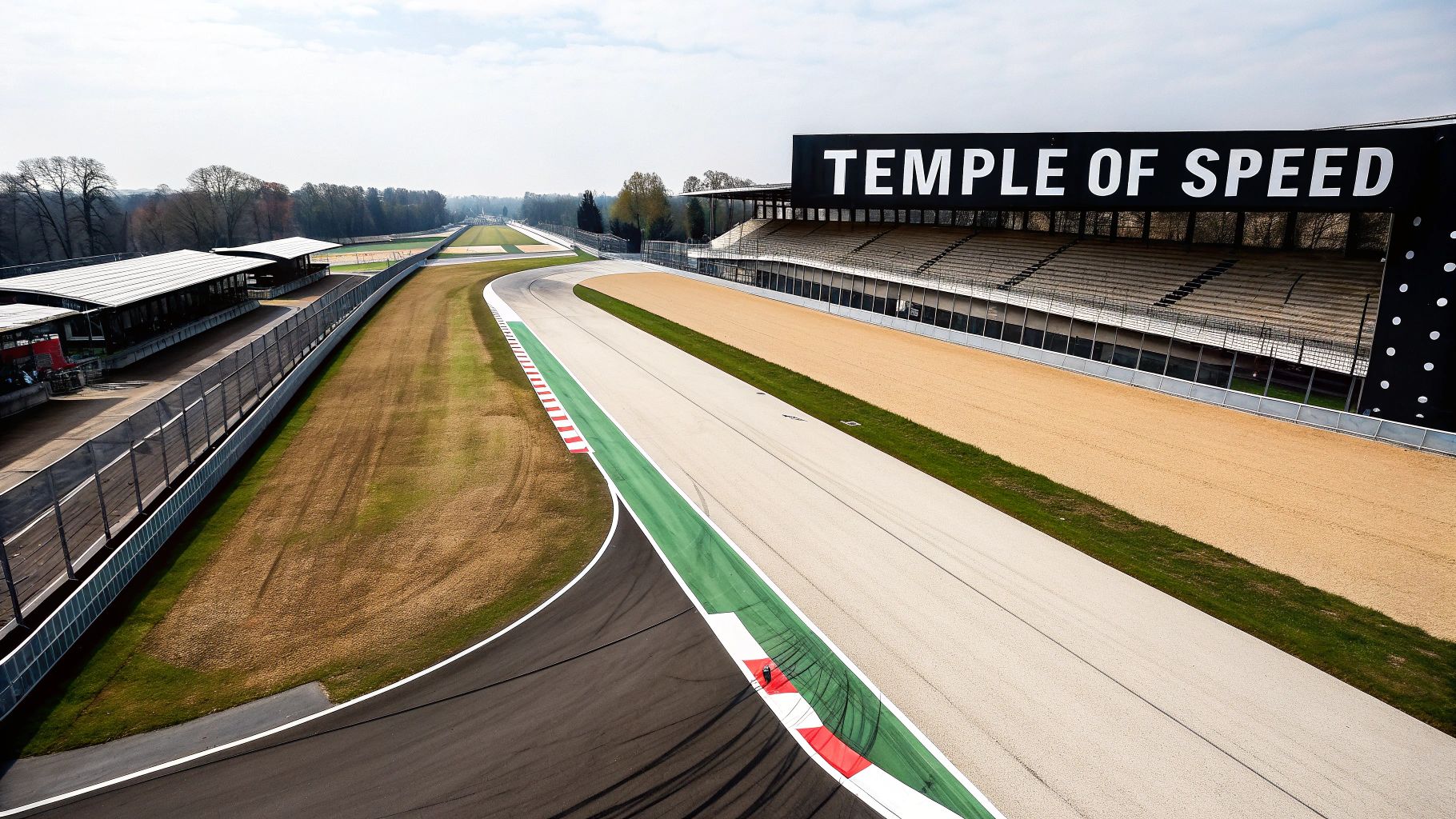
The Autodromo Nazionale Monza is more than just a ribbon of asphalt winding through a royal park; it's a living, breathing monument to motorsport. Its clockwise layout is a simple but brutal philosophy: long, flat-out straights punctuated by heavy braking into tight chicanes. This forces teams into a very specific low-downforce setup, prioritizing straight-line speed over everything else.
Drivers spend what feels like an eternity with their foot pinned to the floor, blasting down legendary straights like the Rettifilo Principale, only to stomp on the brakes for chicanes that feel impossibly slow. This constant cycle of extreme acceleration and savage deceleration puts incredible strain on the car’s power unit and braking system.
To truly understand Monza, let's break down its key statistics in the current Grand Prix configuration.
Monza Circuit at a Glance
| Feature | Specification |
|---|---|
| Length | 5.793 km (3.6 miles) |
| Turns | 11 (7 Right, 4 Left) |
| Lap Record | 1:18.887 (Lewis Hamilton, 2020) |
| Race Laps | 53 |
| DRS Zones | 2 (Main Straight & Curva Grande) |
| First Grand Prix | 1950 |
| Direction | Clockwise |
These numbers paint a picture of a circuit that is all about maximizing speed and managing the few, critical corners.
Core Characteristics of the Monza Layout
Every engineer and driver has to get their head around a few key elements to be competitive here:
- Minimal Downforce Configuration: Teams bring their "skinniest" wings of the season to Monza. This sheds drag to hit those mind-boggling top speeds, but it also makes the cars feel light and twitchy in the corners.
- Heavy Braking Zones: The run into the first chicane, the Variante del Rettifilo, is one of the biggest stops on the F1 calendar. Drivers have to scrub off speed from over 350 km/h in just a couple of seconds.
- High-Speed Corners: Turns like the sweeping Curva Grande (Turn 3) and the final, legendary Curva Alboreto (formerly the Parabolica) are all about commitment. Drivers have to trust the car completely as they carry incredible speed through them.
Monza’s layout forces a compromise. You have to sacrifice cornering grip for raw speed on the straights. It’s a thrilling balancing act between aerodynamic efficiency and pure mechanical grip.
This fundamental trade-off is precisely what makes racing at Monza so captivating. It’s a circuit that rewards both clever engineering and sheer driver bravery, cementing its status as an icon. Enthusiasts can explore our collections of other legendary race tracks to see how different circuit designs create their own unique challenges.
The Evolution of Monza: From Terrifying Banks to Tactical Chicanes
The Monza we know today, a flat-out blast punctuated by tight chicanes, is a world away from its original, much more terrifying design. The track's story is a fascinating push-and-pull between the raw pursuit of speed and the non-negotiable demand for safety. It wasn't born with the familiar chicanes; its first incarnation was an absolute monster built for a different, wilder era of racing.
The Fearsome Banking of a Bygone Era
When the Autodromo Nazionale Monza was carved out of the Royal Villa park in 1922, it was a beast. The original circuit was a colossal 10-kilometer monster that stitched a traditional road course together with a heart-stopping, high-banked oval. Imagine a 5.5 km road section flowing into a 4.5 km oval with concrete banking angled at up to 38.69 degrees—steep enough to feel like you were driving on a wall.
This configuration allowed for mind-bending speeds, but as cars got faster, the danger level went off the charts. The inherent risks of the banking became tragically obvious. You can dive deeper into these formative years and discover more about the legacy of the Monza circuit in our dedicated article.
By the late 1930s, the first major rebuild had already demolished the original oval and given us the iconic Curva Parabolica. But the hunger for speed brought back a new, shorter banked oval in the mid-1950s, once again creating a 10 km layout. This second life was brief. The combined course was just too dangerous for the increasingly potent single-seaters of the 1960s. The final Formula 1 race to use the banking was in 1961, a day tragically marred by the accident that killed Wolfgang von Trips and 15 spectators. It was a clear turning point; the high banks would never again be part of a Grand Prix.
Taming the Beast with Chicanes
Even with the banking gone, Monza was still terrifyingly fast. Throughout the 60s and early 70s, cars were hitting insane speeds on the long straights, which inevitably led to more horrific accidents. The relentless pursuit of safety demanded a radical rethink of the circuit’s entire philosophy.
Monza’s history is a constant negotiation with speed. The track's soul is its long straights, but its survival has depended on finding ways to tame them without destroying its character.
This led to the most significant changes to the modern layout. In 1972, the organizers introduced two chicanes specifically designed to break up the long, flat-out sections and force drivers to hit the brakes hard.
- Variante del Rettifilo: This slow, right-left flick was dropped in right at the end of the main straight, dramatically cutting the entry speed into the sweeping Curva Grande.
- Variante Ascari: Further around the lap, a fast, flowing sequence of corners replaced a single, quick curve. This addition, just before the back straight leading to Parabolica, demanded immense technical precision.
These changes completely transformed the rhythm of a lap at Monza. It was no longer just about horsepower and bravery. The circuit now demanded incredible braking power, stability, and a driver's delicate touch through the new slow sections. This evolution, born from tragedy, created the legendary layout that continues to push the world's best drivers to their limits today.
A Virtual Lap of the Monza Circuit
To really get a feel for the Monza track layout, you have to imagine yourself in the driver's seat. Picture this: you’re strapped into a modern Formula 1 car, the engine shrieking behind you as you blast down the legendary 1.1 km main straight, the Rettifilo Principale.
You’re easily hitting speeds over 350 km/h when the 150-meter board flashes past. That’s your cue to hit the brakes—and hit them with everything you’ve got. This isn't just braking; it's a controlled, violent deceleration, one of the most punishing braking zones in all of motorsport.
The First Chicanes and Curva Grande
Your first real test is the Variante del Rettifilo, a tight right-left chicane that’s practically synonymous with first-lap chaos. Nailing the entry is everything. You have to be aggressive, riding the kerbs hard to shave off milliseconds without throwing the car off balance. A clean exit here is your slingshot into the next iconic section.
Almost immediately, you’re flying into Turn 3, the Curva Grande. You don't brake for this one. It's a massive, full-throttle, sweeping right-hander that you take on pure commitment. With the low-downforce setup everyone runs at Monza, the car feels incredibly light and twitchy here. It's a pure test of guts and aerodynamic grip.
Next up is the Variante della Roggia. This left-right chicane is a prime spot for a divebomb overtake, but it’s just as easy to get it wrong and lose a massive chunk of time. Precision is the name of the game, attacking the entry kerb to set yourself up for the perfect, powerful exit.
The Lesmos and the Ascari Challenge
A short burst of acceleration brings you to one of Monza’s most famous and technical sequences: the Lesmo corners. Lesmo 1 is a fast right-hander that seems to tighten up just as you're exiting. You need real patience on the throttle here, or you’ll find yourself running wide and into the unforgiving gravel.
Right after, you’re thrown into Lesmo 2. It's a bit slower but just as tricky, and its exit is absolutely critical. A good run out of Lesmo 2 sets you up for the long straight leading to one of the most beloved sections of the entire monza track layout.
The Variante Ascari is less of a chicane and more of a high-speed dance. It's a flowing left-right-left sequence where drivers flick the car from kerb to kerb, carrying an astonishing amount of speed through the whole complex.
Getting Ascari right is all about rhythm. Every steering input has to be smooth and deliberate. Any hesitation or mistake here compromises your speed all the way down the next straight, and it’s where you can really see the great drivers shine.
Over the decades, the track has changed dramatically to improve safety, moving away from its original banked ovals to the modern layout defined by these chicanes.
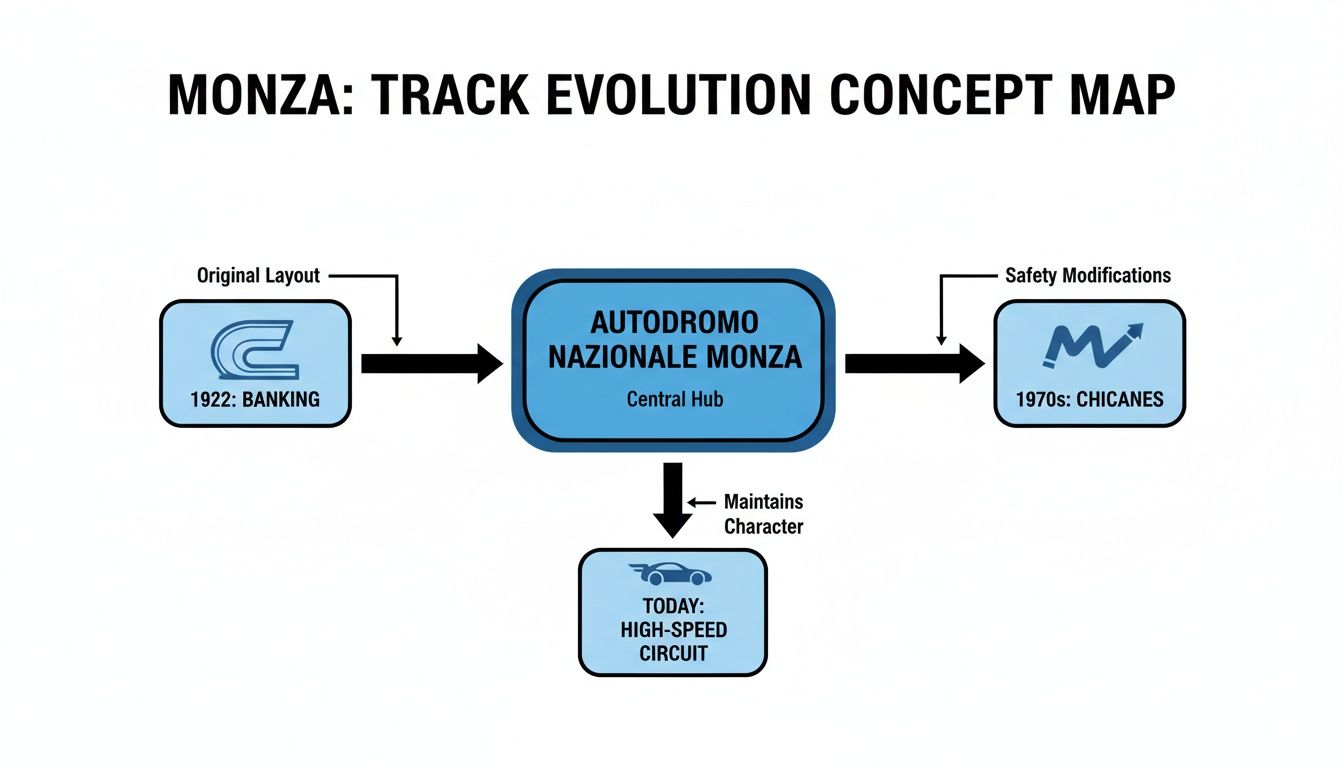
As you can see, Monza has constantly evolved. The chicanes, first added in the 1970s, were a direct response to ever-increasing speeds, but they were designed to preserve the circuit's fundamental high-speed character.
The Legendary Final Corner
The entire lap builds to this moment: the magnificent Turn 11, Curva Alboreto. For generations, it was known simply as the Parabolica, and it remains one of the most iconic corners in all of motorsport.
The entry is incredibly fast, and the long, sweeping right-hander feels like it goes on forever. It gradually opens up on exit, tempting you to get on the power early. But you have to perfectly balance the throttle to avoid scrubbing off speed or, worse, sliding wide.
Nail the exit, and the car slingshots you back onto the main straight to do it all over again.
Even with all the changes, the soul of Monza remains in layout gems like the flowing Lesmos, the Parabolica's massive 395m radius exit, and the modern first chicane—redesigned after 2000 to encourage overtaking, though its tightness still guarantees some first-lap drama. You can discover more about Monza's intricate history and see how it became the legend it is today.
Mastering Car Setup and Driving Strategy at Monza
To win at Monza, you have to throw out the rulebook. It's a track that rewards surgical precision over brute force, and that philosophy starts in the garage long before the lights go out. Everything—and I mean everything—is about one thing: minimizing drag.
The long straights demand a radical low-downforce setup. You’ll often hear teams and commentators talk about a special "Monza-spec" wing, and for good reason. Think of a normal F1 rear wing as a massive upside-down airplane wing, pushing the car onto the track for incredible grip in the corners. At Monza, that same wing is just a giant airbrake.
So, teams bolt on the skinniest, flattest wings they have, sacrificing huge amounts of cornering grip just to gain a few extra miles per hour on the straights. This creates a real knife-edge dilemma. With so little downforce, the car feels light and nervous, almost like it's floating through the faster corners like the Curva Grande and Curva Alboreto. It’s a real handful.
The Balancing Act: Braking and Kerb-Riding
With aerodynamics compromised, the focus shifts entirely to mechanical grip—what the car can generate from its tires and suspension. This is most obvious under braking. Imagine hurtling toward the first chicane at over 350 km/h and then slamming on the brakes with almost no aerodynamic help to keep you stable. The car squirms and dances, and it takes a driver with immense confidence to tame it.
"At Monza, you're constantly fighting a car that's been engineered to do the opposite of what you need in the corners. The setup is all about the straights, so the driver has to make up the difference everywhere else."
To find those last few tenths, a driver has to get aggressive with Monza’s infamous kerbs. The chicanes are so tight that the fastest way through is to cut them, launching the car over the kerbs. This demands a very specific setup philosophy.
- Softer Suspension: You need a car that can soak up the violent hits from the kerbs without getting thrown off balance.
- Ride Height Tweaks: Engineers and drivers work to find the perfect ride height that allows them to attack the kerbs without bottoming out and damaging the car's floor.
A fast lap here means using the kerbs at Variante del Rettifilo and Variante della Roggia to effectively straighten out the corners. It’s all about maintaining momentum. But that aggression has to be tempered with absolute precision on the exit of the final corner, Curva Alboreto. One small mistake there will kill your speed all the way down the start-finish straight, ruining your lap time. It's a beautiful, delicate dance between raw aggression and pure finesse.
Monza by the Numbers: The Records That Built a Legend
"Temple of Speed" isn't just a clever nickname—it's a reputation forged over a century of heart-stopping, record-shattering moments. The Monza track layout was built for one thing and one thing only: raw, untamed speed. Look at the data, and you'll see why. Drivers keep the throttle pinned to the floor for a staggering 80% of a lap, one of the highest figures you'll find anywhere in motorsport.
This relentless focus on power produces some truly mind-boggling stats. For example, the average speed for a qualifying lap routinely tops 260 km/h (161 mph), cementing Monza's place as the fastest track on the Formula 1 calendar, no questions asked. The long, flowing straights let the cars hit their absolute maximum velocity, pushing engines, aerodynamics, and driver nerve to the very edge.
Where Lap Times Become Legend
At Monza, the lap records are what etch a driver's name into history. While official F1 race lap records can only be set during the Grand Prix itself, the all-out fastest times are almost always clocked in qualifying, when the cars are light on fuel and shod with brand-new tires.
Every record set at Monza is a testament to the perfect marriage of engineering genius and pure human bravery. The numbers aren't just about speed; they're about a legacy built by those who dare to push the absolute limits.
The sheer pace is hard to comprehend. It was here that Lando Norris clocked the fastest-ever F1 race lap in World Championship history, a blistering 1:20.901 at an average speed of 257.781 km/h (160.178 mph). The two-wheeled machines are just as incredible, with a motorcycle lap record of 1:42.121. But all that speed comes with a price; since 1993, the Safety Car has made an appearance in 31% of races, a reminder that chaos is always just around the corner. You can dive deeper into Monza's extensive racing history and the records that define it.
The Stats Behind the "Temple of Speed"
To get a real sense of what a lap around Monza feels like, you have to look at the forces at play. These are the numbers that truly define its brutal character:
- Top Speed: On the main straight, cars frequently rocket past 350 km/h (217 mph) before slamming on the brakes for the first chicane.
- Braking Force: That first braking zone into Turn 1 is one of the most violent of the entire season. Drivers have to bleed off an unbelievable amount of speed in a blink of an eye.
- Gear Changes: A driver might only shift gears about 40 times per lap. That's way down on what you'd see at a twisty track, and it highlights just how much of the lap is spent flat-out.
These metrics perfectly illustrate why the monza track layout is in a league of its own. It’s a circuit that demands raw horsepower and unwavering commitment, cementing its status as the place where speed records aren't just broken—they're utterly demolished.
Bringing the Thrill of Monza Home
When you truly understand the Monza track layout, you're not just looking at a ribbon of tarmac. You're seeing a story unfold—a saga of blistering speed, knife-edge strategy, and moments that have become motorsport legend.
Think about it. From the savage braking into Variante del Rettifilo to the unwavering, full-throttle commitment through Curva Alboreto, every single inch of this circuit tells a tale. Now, what if you could capture that entire narrative and hold it in your hands?
This is where a real passion for motorsport engineering inspires physical design. Monza's iconic shape, with its impossibly long straights and famous chicanes, translates beautifully into a tangible form. It's not just a decoration; it’s a conversation piece and a genuine tribute to racing history.
From Digital Guide to Physical Art
For anyone who lives and breathes racing, showing that passion is part of the fun. A beautifully crafted track sculpture is more than just wall art; it’s a daily reminder of the raw drama and pinpoint precision that defines the Temple of Speed.
- Celebrating Iconic Design: It perfectly captures the circuit's unique flow and unmistakable character.
- A Statement Piece: It's the ideal focal point for an office, media room, or personal collection.
- Honoring History: Every curve and straight represents decades of legendary racing moments.
A premium wood track sculpture isn't just a map; it's a celebration of the engineering and driver skill required to conquer one of motorsport's most revered circuits.
By turning the legendary Monza track layout into a tangible tribute, you can bring a piece of motorsport heritage right into your home. If you're inspired to see how this iconic circuit is brought to life, you can explore the premium wood Monza circuit art from SCUDERIA 3D.
Your Monza Questions Answered
Monza is a track that seems simple on paper, but it's full of nuance and history. Even if you've been following motorsport for years, certain details can spark curiosity. Let's tackle some of the most common questions about the legendary "Temple of Speed."
So, How Many Corners Are There Really?
Officially, the Monza circuit is listed with just 11 turns. This incredibly low number is the secret to its insane speeds, favoring pure, flat-out straights over a maze of technical corners.
Of course, a few of those turns are now household names for any F1 fan, like the challenging double-apex Lesmos or the legendary final corner, the Curva Alboreto.
What Makes Overtaking at Monza Such a Spectacle?
Passing at Monza is a high-risk, high-reward art form. The cars are trimmed out with minimal downforce to be slippery on the straights, but that makes them notoriously twitchy and unstable when drivers slam on the brakes. It's a real nail-biter.
The best action usually unfolds in a few key spots:
- Turn 1 (Prima Variante): This is the single heaviest braking zone on the entire circuit. It’s the classic spot for a divebomb, where late-braking heroes are made.
- Turn 4 (Variante della Roggia): Another sharp chicane that demands full commitment. It’s a place where you often see cars running wheel-to-wheel, fighting for position.
- Turn 11 (Curva Alboreto): You don't typically see a pass in the corner itself, but getting a perfect exit here is absolutely critical. A good launch onto the pit straight sets up a prime DRS-assisted overtake into Turn 1.
Why Do They Call It the "Temple of Speed"?
That nickname isn't just for show—it’s a statistical fact. Monza boasts the highest average speed of any track on the Formula 1 calendar. We're talking qualifying laps that average over 260 km/h (161 mph).
Think about this: drivers have their foot planted to the floor, at full throttle, for around 80% of the entire lap. No other current F1 circuit even comes close to that figure.
It's a unique formula: incredibly long straights, cars running the skinniest wings they'll use all year, and a handful of violent braking zones. This mix creates a challenge that's all about raw horsepower and nerve, cementing its legendary status.
This raw, unfiltered pace is precisely why the Monza track layout is so beloved by fans who come to see cars at their absolute limit.
At SCUDERIA 3D, we capture that legendary speed and flow in stunning visual art. If you want to bring the essence of motorsport's most historic circuits into your space, check out our premium 3D and wood track sculptures by visiting our official SCUDERIA 3D website today.
Article created using Outrank