

A Complete Guide to the Monaco Track Layout
The Circuit de Monaco isn't just a racetrack; it's a tightrope walk between glamorous apartment buildings and the glittering Mediterranean Sea. The Monaco track layout is legendary for its mix of impossibly narrow streets, blind corners, and dramatic elevation changes, making it the ultimate test of pure driver skill in Formula 1.
Why This Street Circuit Captures the Imagination
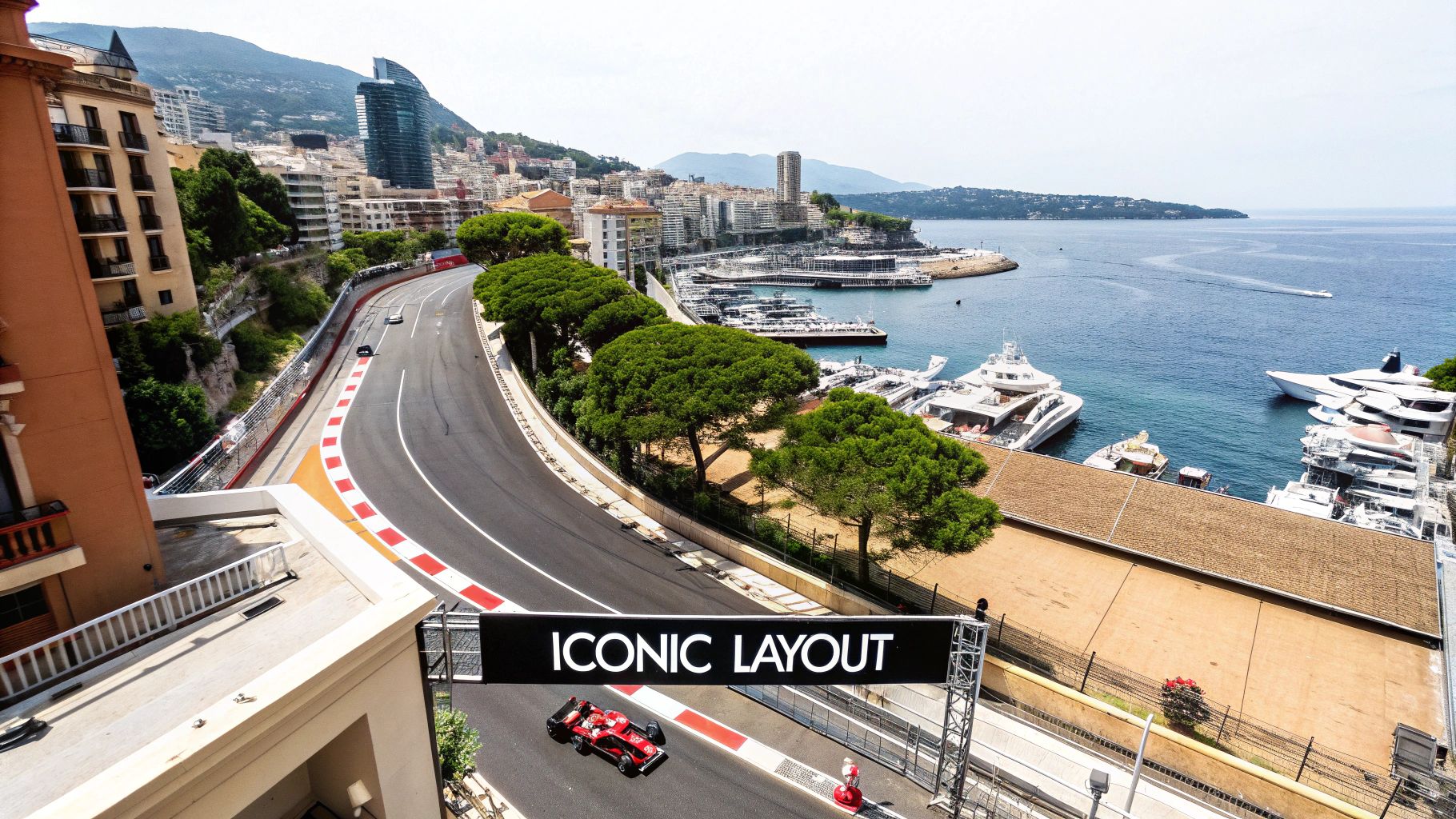
Unlike purpose-built circuits with vast run-off areas and sweeping, gentle corners, Monaco is a temporary beast. It's assembled piece by piece each year on the public roads snaking through Monte Carlo and La Condamine.
This incredible transformation turns a bustling city into a high-speed labyrinth where precision is everything. There is absolutely zero margin for error. A momentary lapse in concentration sends a multi-million-dollar machine straight into the unforgiving Armco barriers that line the track. This constant threat is what makes the layout so compelling—it’s a throwback to a bygone era of motorsport, where the circuit itself is as much a competitor as the other drivers on the grid.
A Test of Pure Driver Skill
Modern F1 cars are engineered for incredible downforce and high-speed stability. The Monaco track layout completely flips that on its head, forcing these machines into their least comfortable state: slow, twitchy, and constantly on the edge of control. The average speed here is the lowest on the entire F1 calendar, but the mental workload is by far the highest.
The circuit demands that drivers operate at the absolute peak of their abilities for 78 laps straight. It’s less about outright speed and more about rhythm, confidence, and millimeter-perfect placement. As Nelson Piquet famously said, racing here is like "riding a bicycle around your living room."
This unique challenge creates a spectacle that isn't about daring overtakes—there are hardly any—but about sustained, flawless execution. The track elevates pure driving talent over raw car performance, which is why a victory here is often considered more prestigious than a World Championship by the drivers themselves.
This guide will break down the iconic Monaco track layout, offering insights for:
- F1 Fans wanting to understand race strategy and the unique challenges drivers face.
- Sim Racers aiming to master every single apex and braking point of this demanding circuit.
- Motorsport Enthusiasts fascinated by the intersection of engineering grit and historic glamour.
We'll explore every corner, sector, and straightaway, giving you a detailed analysis that brings this legendary circuit to life.
The Anatomy of a Legendary Street Circuit
To really get what makes the Monaco Grand Prix so special, you have to look at its raw stats. This isn't some purpose-built, sprawling super-circuit with massive runoff areas. Monaco is a throwback, a temporary track squeezed into the impossibly tight confines of a city-state. It's less a racetrack and more a high-speed, high-stakes puzzle woven through city streets.
Think of a modern track like a big, open highway. Monaco, on the other hand, is like trying to pilot a fighter jet through a winding back alley. Every turn is a test, every move is critical, and there is absolutely zero room for error. This creates a relentless, rhythm-based challenge where a driver's mental focus is every bit as important as their raw skill.
The Numbers Behind the Legend
Let's break down the stats that make this track so legendary. The Circuit de Monaco is a narrow ribbon of asphalt that winds through the principality's most famous landmarks.
Below is a quick overview of the essential numbers that define the Monaco challenge.
Circuit de Monaco Key Statistics
| Statistic | Measurement |
|---|---|
| Track Length | 3.337 km (2.074 miles) |
| Number of Laps | 78 |
| Race Distance | 260.52 km (161.88 miles) |
| Number of Corners | 19 (7 Left, 12 Right) |
| Slowest Corner | Fairmont Hairpin (~50 km/h or 30 mph) |
| Fastest Point | Tunnel Section (~290 km/h or 180 mph) |
| First Grand Prix | 1950 |
These figures really highlight just how compact and intense the circuit is. For more historical context, you can explore the Monaco circuit's history on F1-Fansite.com.
That sheer concentration of corners means drivers are constantly wrestling with the steering wheel, with hardly a moment to catch their breath on the short straights. It’s this demanding nature that has cemented its legendary status.
Monaco is a circuit of the mind. Overtaking is almost impossible, so qualifying is everything. A driver must find a perfect rhythm and maintain absolute focus lap after lap, knowing one tiny mistake will end their race against the barriers.
This compact, unforgiving design is what elevates the driver above the car. While raw power is king at places like Monza, it's precision and sheer nerve that bring success in Monaco. The layout is so extreme that teams have to run maximum downforce and even use special steering setups just to get the cars around the corners.
Capturing these unique characteristics is at the heart of our approach to designing track sculptures, where we work to translate the circuit's one-of-a-kind personality into a physical piece of art. Before we dive into a corner-by-corner breakdown, these stats give you the essential context for the challenge ahead.
A Corner-by-Corner Tour of the Monaco Layout
Let's take a lap around the Circuit de Monaco. You'll find 19 turns packed into its short length, but calling them mere "turns" doesn't do them justice. These are legendary pieces of tarmac, each with a story to tell and a unique challenge that has defined championships and crushed the dreams of motorsport giants. To be fast here, you need more than just a good car; you need an almost fanatical level of precision, aggression, and raw courage.
The lap starts with a very short blast down the main straight before you're immediately hard on the brakes for Turn 1, Sainte Dévote. This tight, 90-degree right-hander is an absolute magnet for chaos on the opening lap. Nail the exit, and you're slingshotted up the steep hill of Beau Rivage, a breathtaking climb toward the world-famous Casino Square.
The Climb to Casino Square
After that steep climb, drivers are thrown into the long, sweeping left-hander of Massenet (Turn 3). It’s a completely blind corner where you have to put absolute faith in the car's grip. Right after, you're into the equally iconic Casino Square (Turn 4), a deceptively fast right-hander where cars get so close to the barriers they practically kiss them on exit. One tiny miscalculation here, and your race is over before it's even truly begun.
From there, the track plunges downhill toward the Mirabeau corners. The dramatic elevation changes are a core part of what makes Monaco so special, forcing drivers to constantly adapt.
This infographic gives you a quick snapshot of just how unique this circuit really is.
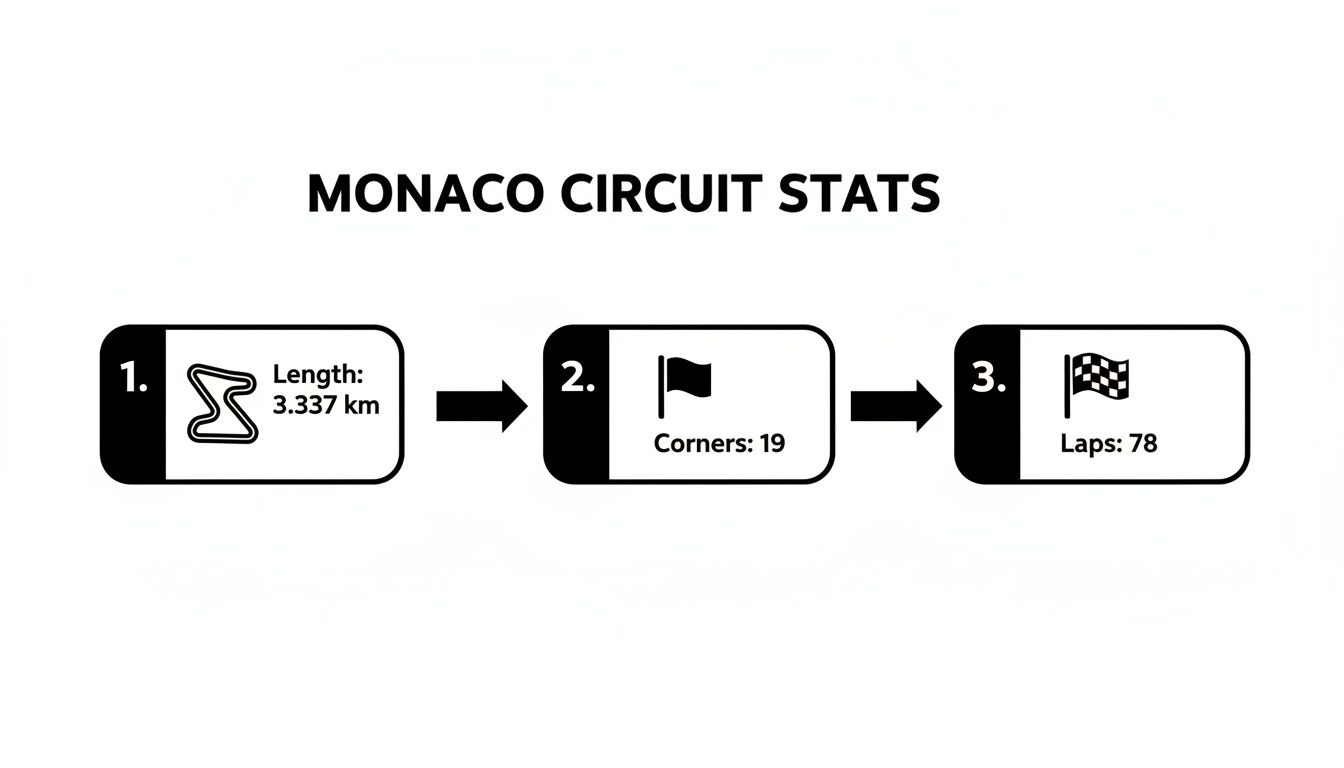
Think about it: a short lap packed with corners, repeated over and over. It's a relentless mental and physical test with absolutely no room to breathe.
As the track drops away from Casino Square, drivers brake hard for Mirabeau Haute (Turn 5), a tight right-hander that acts as the setup for the most famous corner in all of Formula 1.
The Fairmont Hairpin (Turn 6), which older fans will know as the Loews Hairpin, is the single slowest corner on the entire F1 calendar. Drivers crawl through it at just 30 mph (about 50 km/h) and need a special steering rack fitted just to make the turn.
A clean exit from that hairpin is critical. It sets you up for the run down to another right-hander, Mirabeau Bas (Turn 7), before a short burst of throttle towards Portier (Turn 8). This is the exact spot where Ayrton Senna, leading comfortably in 1988, famously put his car into the wall—a moment that has become a permanent part of F1 lore.
Through the Tunnel and by the Sea
Leaving Portier, the cars dive into the darkness of the legendary Tunnel, the only place on the circuit they can go flat out. You emerge from the dark, blinking into the bright Riviera sunlight, and have to immediately slam on the brakes for the Nouvelle Chicane (Turns 10 and 11). This is one of the few real overtaking spots, but it's an incredibly high-risk move.
From here, the track literally hugs the harbor. Tabac (Turn 12), a fast left-hand kink, demands breathtaking precision as drivers thread the needle between the barriers at incredible speed. This corner fires them directly into the beautiful but treacherous Swimming Pool complex.
The first part is a lightning-fast left-right chicane (Turns 13 and 14) and is easily one of the most spectacular sections of the monaco track layout to watch. That's followed instantly by a slower, more technical right-left combination (Turns 15 and 16) that demands a delicate touch on the throttle.
The Final Sprint to the Line
The final part of the lap might just be the most difficult. La Rascasse (Turn 18) is a tight, off-camber right-hander named after the famous bar nestled on its inside. It's an awkward, clumsy corner that loves to catch drivers out, especially late in the race on worn-out tires.
The very last challenge is Anthony Noghès (Turn 19), another tight right that requires a perfect exit to carry as much speed as possible across the start-finish line.
Putting together one clean lap here is a massive accomplishment. To do it 78 times is what separates the great drivers from the true legends. The circuit's unforgiving nature is why it has produced some of motorsport's most memorable moments, including nine of the top ten closest finishes in F1 history. You can find more incredible stats on the Monaco Grand Prix on the official Formula 1 website.
How the Monaco Track Layout Has Evolved
While the heart and soul of the Circuit de Monaco feel timeless, the ribbon of asphalt itself has seen some crucial nips and tucks over the decades. Unlike a purpose-built track that can be completely redesigned, the Monaco track layout is locked in by the city's ancient streets. This means its evolution has been a story of subtle refinements, mostly driven by the need to keep drivers safe as Formula 1 cars got terrifyingly fast.
The circuit drivers race today isn't a carbon copy of the one from the 1950s. The fundamental challenge—threading a high-speed needle through an unforgiving urban maze—remains the same, but the exact path has been carefully tweaked. Every modification tells a story, showing how this historic venue has adapted to the demands of modern motorsport without losing the legendary character that makes it so special.
The Chicane That Changed Everything
One of the biggest game-changers in the track's history was the addition of the Nouvelle Chicane in 1986. Before that, drivers would rocket out of the tunnel and scream towards the Tabac corner with almost nothing to scrub off speed. It was an incredibly dangerous section of the track, a fact tragically proven by a number of serious accidents.
The old layout featured a much faster, less forgiving chicane. The switch to the tight left-right flick we see today was a direct response to that danger. It completely changed the rhythm of the lap, creating a massive braking zone and one of the circuit’s very few—and very risky—overtaking spots.
Major Layout Reshuffles
Beyond that famous chicane, other big changes have sculpted the modern circuit we know and love. The most significant overhaul happened back in the early 1970s, completely reshaping the run along the harbor.
Here are a few of the key changes over the years:
- The Swimming Pool Section (1973): Can you imagine the track without it? Before '73, the cars just ran straight from Tabac to an old hairpin at the Gasworks. When the Rainier III Nautical Stadium was built, race organizers routed the track around it, creating the iconic and incredibly technical Swimming Pool complex with its two lightning-fast chicanes.
- La Rascasse and Anthony Noghès (1973): That old Gasworks hairpin was also replaced, making way for the tight, awkward La Rascasse corner and the final turn named for the race's founder.
Since its beginnings in 1929, the circuit has grown from the 3.312 km version used from 1976-1985 to the 3.337 km layout we have today. This shows how the monaco track layout has been strategically massaged over time to improve safety while keeping its core identity intact. You can learn more about the history of the Monaco Circuit and see how these iconic features came to be.
The evolution of Monaco is a constant balancing act between preserving its raw, historic challenge and ensuring the safety of modern drivers. Every tweak and turn tells a story of speed, risk, and the relentless quest to push limits within the city's unyielding confines.
These historical adjustments aren't just trivia; they are vital chapters in the circuit's biography. They show a deep commitment to adapting with the times while fiercely protecting what makes Monaco, well, Monaco.
Bringing the Monaco Layout into Your Home
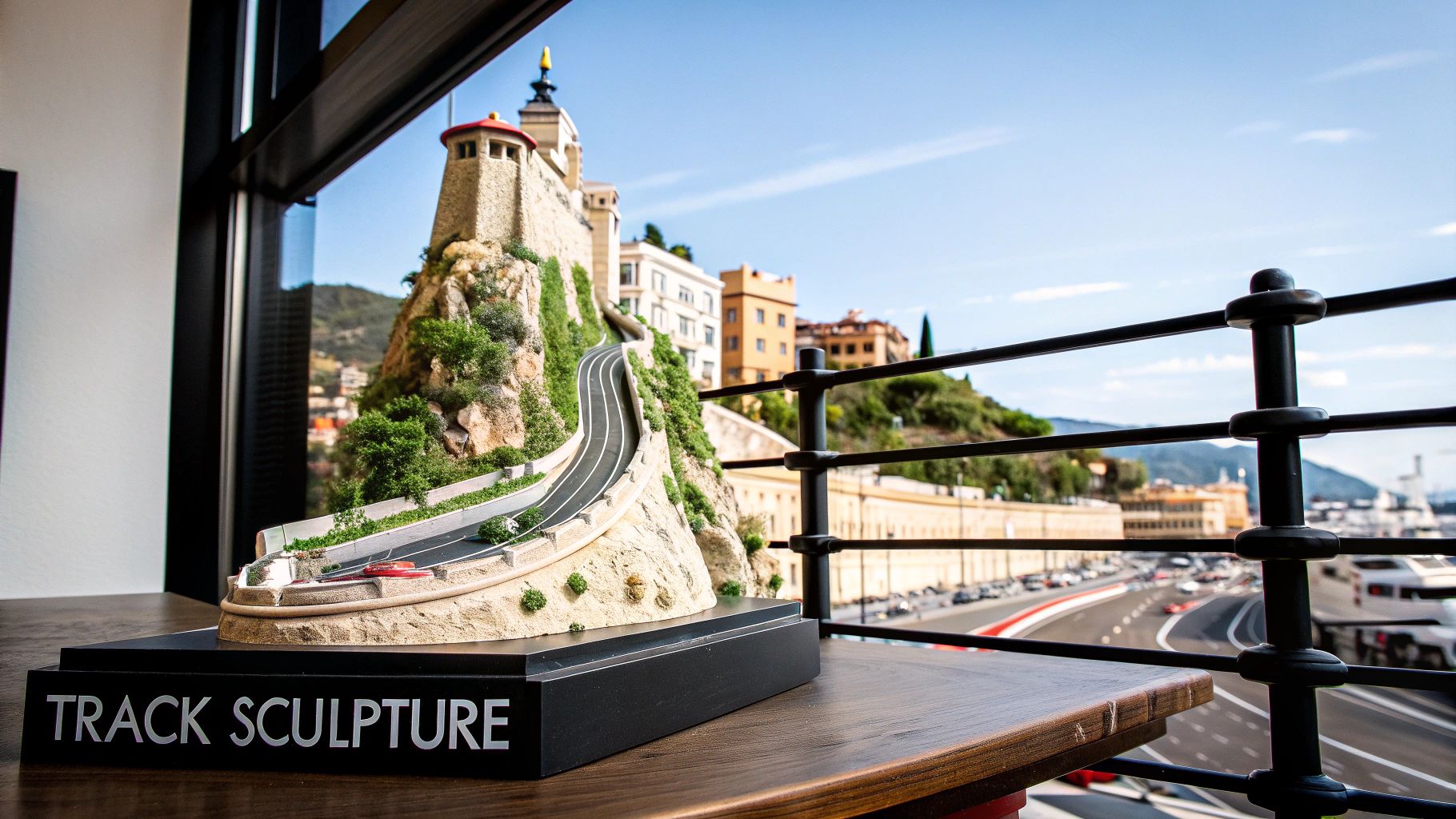
Watching the Monaco track layout on TV is one thing, but truly grasping its physical complexity is a different challenge altogether. A standard two-dimensional map shows you the sequence of corners, sure, but it completely misses the one element that defines this place: the constant, dramatic changes in elevation.
This is where a three-dimensional track sculpture really shines. It transforms the circuit from a flat line on a screen into a physical object you can hold, see, and touch, offering a completely fresh perspective on this legendary layout.
Visualizing the Challenge in 3D
Imagine running your finger up the steep, demanding climb of Beau Rivage towards Casino Square. You can physically feel the sharp plunge down through Mirabeau and Portier just before the cars dive into the famous tunnel.
A 3D model brings these unique characteristics to life in a way that overhead graphics just can't match. Having a physical representation helps you visualize the incredible forces at play and appreciate the sheer skill it takes to wrestle a car through these streets during a race.
For sim racers and motorsport enthusiasts, a detailed model becomes more than just a piece of art; it's a practical study tool. It allows you to analyze the intricate geometry, camber changes, and elevation shifts that are critical to finding those last few tenths of a second on a virtual lap.
A sculpture of the Monaco track layout is more than just a decoration. It’s an elegant piece for your home, an instant conversation starter, and a tool for deepening your connection to the sport. You can see just how a race track model of Monaco captures every single nuance of this iconic circuit.
Ultimately, it’s a celebration of the brilliant engineering and timeless design of the world’s most glamorous street circuit, bringing a piece of motorsport history right into your own space.
Common Questions About the Monaco Track Layout
Even with a corner-by-corner breakdown, the sheer uniqueness of the Monaco track layout always sparks a few more questions. Fans, sim racers, and even seasoned motorsport followers often wonder about the specifics of what makes this place tick. Let's tackle some of the most common ones.
Think of this as rounding out your knowledge, filling in the gaps from the practical challenges of racing here to how it translates into the digital world.
Why Is Overtaking So Difficult in Monaco?
To put it bluntly, overtaking in Monaco is next to impossible. There isn't one single reason, but a perfect storm of factors that conspire against it. First off, the track is brutally narrow. We're talking about a ribbon of tarmac designed for city traffic decades ago, not for modern, wide Formula 1 cars to go wheel-to-wheel.
Then you have the layout itself—it's just one tight, slow corner after another. There are no long straights where a driver can get a good tow and pull alongside. Even the main pit straight, the track's only DRS zone, is comically short and doesn't offer nearly enough space for a clean pass. A successful move here usually comes down to a desperate, high-risk lunge into a braking zone like the Nouvelle Chicane, a perfectly executed pit strategy, or an opponent making a critical mistake.
The barriers are the final nail in the coffin. They are right there, lining every inch of the circuit. Unlike tracks with forgiving run-off areas, a misjudged move in Monaco doesn't just cost you a place—it almost guarantees a race-ending crash for one or both cars.
This is exactly why qualifying is king in Monaco. Securing pole position on Saturday is often more than half the battle won for Sunday's race.
What Is the Most Famous Corner on the Circuit?
Monaco is a highlight reel of iconic corners—Casino Square, Rascasse, Tabac—but if you have to pick just one, it has to be the Fairmont Hairpin. You might also know it by its old name, the Loews Hairpin. Its claim to fame? It is, without a doubt, the single slowest corner in all of Formula 1.
Drivers have to practically crawl through this incredibly tight left-hander, slowing to a mere 30 mph (around 50 km/h). The turn is so extreme that teams actually design and fit a special steering rack just for this one race, giving the drivers enough lock to get the car around without having to do a three-point turn.
Its legendary status is sealed by its location, right outside the Fairmont Hotel, making it one of the most photographed and recognizable spots in motorsport. For the drivers, a clean line through the hairpin is crucial; it sets them up for the right-hander at Portier and the plunge into the famous tunnel.
How Does Sim Racing on the Monaco Track Compare to Reality?
For anyone with a sim rig, the Monaco track layout is the ultimate test of skill and a hugely rewarding challenge. A simulator can't replicate the punishing G-forces or the very real sense of danger, but the mental gymnastics and precision required are spot on.
A fast lap in the sim demands mastery of the exact same skills as in the real world:
- Braking Points: Nailing your braking markers lap after lap is everything. Too early and you lose time; too late and you're in the wall.
- Apexes: You have to kiss every apex to maintain the rhythm that a lap of Monaco demands.
- Throttle Application: Squeezing the power on corner exit has to be incredibly smooth to avoid lighting up the rear tires on the slick street surface.
The biggest difference is how you feel the car. A real driver uses the seat of their pants to sense grip and balance, while a sim racer relies on force feedback through the wheel and visual cues on screen. Still, a good simulation perfectly captures the relentless mental focus needed to string together 78 laps between those unforgiving barriers without a single mistake.
Have There Been Any Recent Changes to the Monaco Layout?
The core Monaco track layout has been remarkably consistent for decades, which is a massive part of its heritage and charm. But that doesn't mean it's frozen in time. Small tweaks are made now and then, almost always in the name of safety.
For example, back in 2015, the profile of the fast left-hand Tabac corner was reprofiled slightly to change the entry. The pit lane exit has also been adjusted over the years to help cars rejoin the circuit more safely.
The really significant changes, like the addition of the Swimming Pool complex, happened way back in 1973. Nowadays, any work done on the circuit tends to focus on things like upgrading the barriers with the latest technology, resurfacing the track to improve grip, or sorting out drainage—not on changing the iconic flow that makes Monaco, Monaco.
At SCUDERIA 3D, we capture the elevation, corners, and soul of legendary circuits like Monaco. Transform your space with a piece of motorsport art by exploring our collection at https://scuderia3d.com.
Article created using Outrank